



Migration Illustrated
PRESENTS
The Migratory White Stork
White storks, scientific name Ciconia ciconia, are graceful fliers who use air currents to soar great distances with little effort. Their indirect seasonal routes follow terrain that is ideal for thermal updrafts to allow for energy-efficient gliding. These wading birds can travel thousands of miles each year from their summer breeding grounds in northern Africa, Europe, and Asia to winter as far south as South Africa and back again.
According to mythology and folklore, white storks bring harmony, luck, and new life. There is a common superstition from many cultures that storks arriving in the spring are a sign that human babies are on the way and that storks themselves deliver the newborns. This is most likely due to people seeing these large white birds feeding their hatchlings in nests on top of houses of recent human births.

This beautiful Ciconiidae tends to her chicks in a large stick nest common for the species. Mating pairs typically return to the same nest year after year. White stork nests become massive, up to six feet in diameter and weighing over a ton.

White storks are opportunistic carnivores that forage in the grass for small animals and invertebrates, including beetles, mice, and worms and in shallow water for small species such as crustaceans, fish, and mollusks.
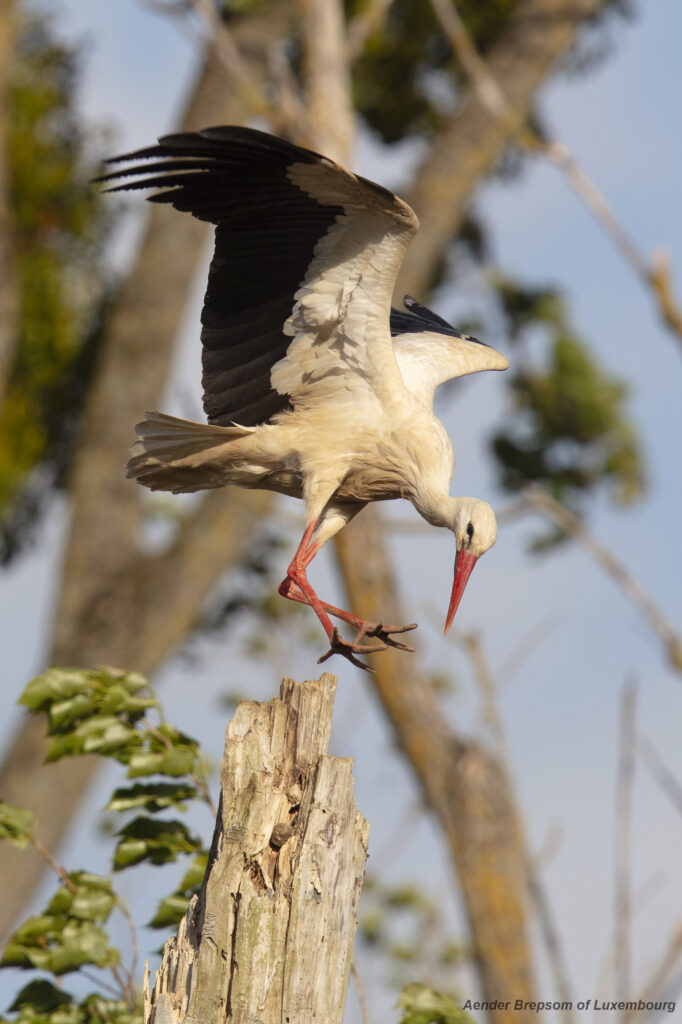
White storks breed in early spring with elaborate mating rituals that include dancing, bill clacking, and wing flapping. Storks are social birds and often mate for life. Both parents build and repair nests, incubate eggs, and feed their young.
These beautiful birds have striking white plumage contrasted by bare black skin around their eyes and black flight feathers. Their long, slender legs are ideal for foraging in grass and wetlands while their bills are long and sharp for hunting. Hatchlings have yellow legs and black bills, whereas the bill and legs of adults are orange/red.
White storks often live near people, nesting on rooftops and foraging in farmlands near farmers working their fields. Mankind has lived among these elegant wading birds since before written history, and throughout time we have developed a special relationship and appreciation for them. Today, many people build platforms and other structures on their houses with the hope that white storks will build nests and bring luck to their homes.

THE LONG AND SHORT OF IT
Name: Ciconia ciconia
Wingspan: 152 to 213 cm (60 to 84 in)
Height: 99 to 121 cm (39 to 48 in)
Weight: 2 to 4.5 kg (4.4 to 9.9 lbs)
Lifespan: ≤ 25 in Wile, ≤ 45 in Captivity
Fledging: 8 Weeks (average)
Breeding: Early to Middle Spring
Offspring: 3 – 5 eggs per clutch
Status: Least Concern
The Migratory White Stork
– – –
A photographic journey along the migration routes of the world’s most fascinating species with some of the wildest road warriors this side of the universe. In color and in style.
