


Primeval Survivor
PRESENTS
The Primal Clouded Leopard
By: Katelin Kukk
Photographs by expert photographer Jim Zuckerman
The elusive Clouded Leopard (Neofelis nebulosa) can be found in Southeast Asia, ranging from Nepal to Bangladesh, and Eastern India to Southern China. Sadly, they are currently extinct in Singapore and Taiwan. Clouded leopards are truly incredible animals known for their stunning appearance and exceptional climbing abilities. Many people are not aware that these cats date back millions of years, making them primeval survivors. Although their name suggests otherwise, they are also not true leopards. Instead, they are a distinct cat species belonging to their own genus, Neofelis.

Appearance
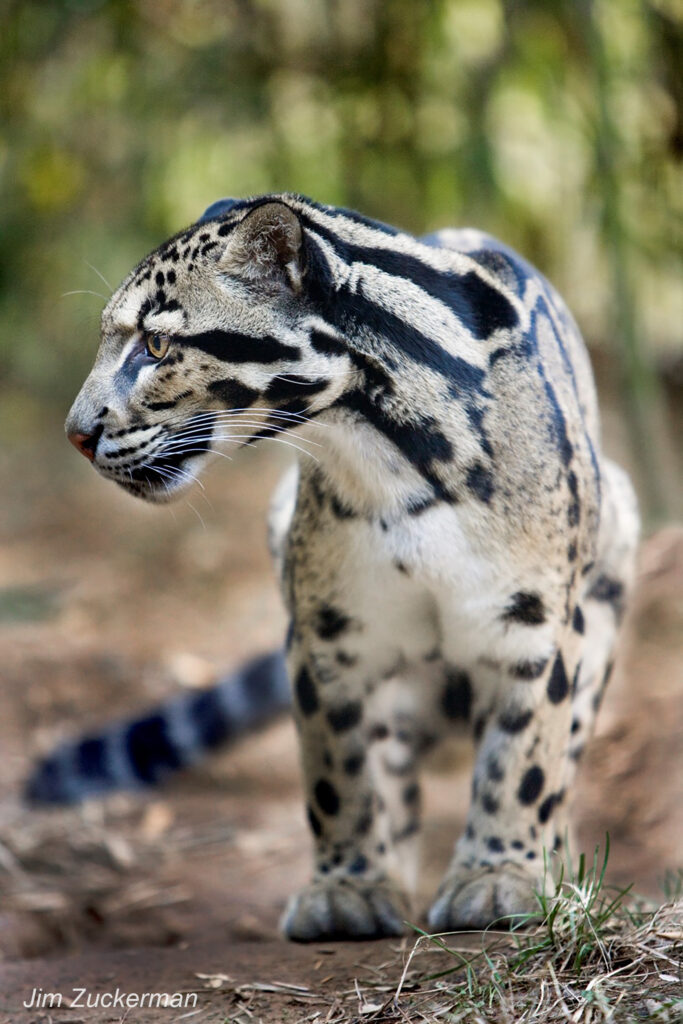
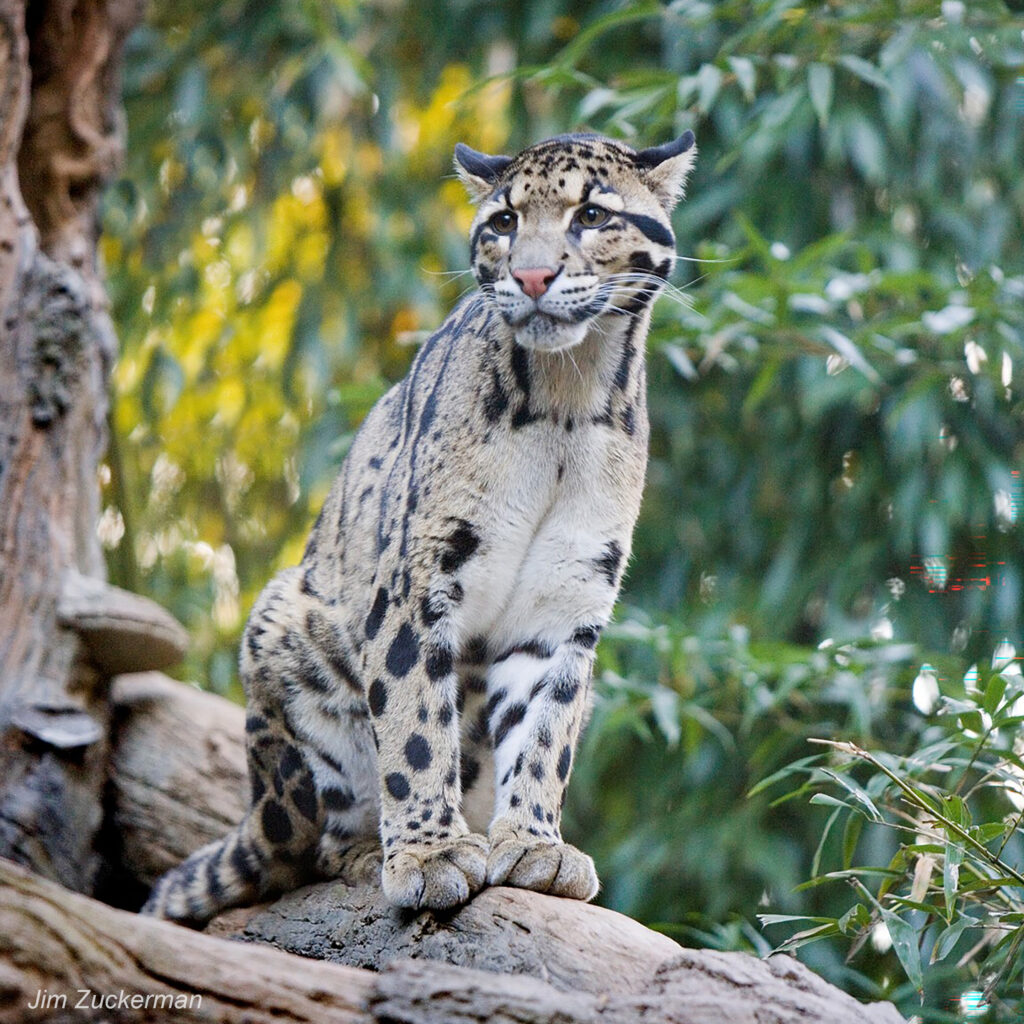
These beautiful cats have a medium-sized build, making them smaller than lions and tigers but bigger than house cats. One of their most recognizable features is their coat, which has a unique coloration; easily identified by dark, irregular cloud-like spots and splotches on a brown to yellow-gray coat, providing excellent camouflage. Clouded leopards also have large paws with specialized foot pads for climbing. They are one of two cat species that possess the unique ability to climb down trees headfirst. Despite their smaller size, they have one of the longest canine teeth, about the same size as a tiger’s, allowing them to take down animals larger than themselves.

Behavior
Clouded leopards are solitary and mostly nocturnal cats, which makes sightings in the wild quite rare. Due to their partially ossified hyoid bone, they cannot roar like lions, nor can they purr. Instead, they communicate by chuffing, growling, or hissing. Clouded leopards were once thought to hunt primarily in trees, but research has revealed that they seem to hunt both in the trees and on the ground. As strict carnivores, they eat small deer, wild boar, gibbons, and other animals. Sexual maturity in these cats is reached by two years of age. As they are sexually dimorphic, males are larger than females, and mating can actually be quite dangerous. Males can become very aggressive during courtship, even accidentally killing the female. Potential pairs introduced at a younger age have a better chance of procreating.
History
In the 1960s, scientists analyzed the skull of a clouded leopard and discovered features evolutionarily linking them to both Panthera (big cats) and Felinae (small cats). Genetic studies later revealed that clouded leopards were the first cat species to diverge from a common ancestor of the Pantherinae group. During the Pleistocene epoch, the cats crossed Asia on a now-submerged land bridge that connected the mainland to Borneo and Sumatra. Around two million years ago, they became isolated and diverged into the two current species: the mainland clouded leopard (Neofelis nebulosa) and the Sunda clouded leopard (Neofelis diardi).
Conclusion
To conclude, clouded leopards are rare and fascinating creatures that inhabit the forests of Asia. With their striking appearance, remarkable abilities, and unique evolutionary history, they play an important role in their ecosystems. They are classified as vulnerable mainly due to habitat loss by logging, farming, and also from poaching. Protecting clouded leopards as well as their habitat is essential to ensure their survival for future generations.
The Primal Clouded Leopard
Photographs by Jim Zuckerman
– – –

Spectacular creatures roamed the earth in the time long before the history of man. Species alive so far in the past, the only traces we find today are bits of rock and stone. Ages faded to dust in the wind. Yet there are those who remain. We call them Primeval Survivors. Do these remnants of the past hold the secrets of the ages?
