


Migration Illustrated
PRESENTS
Ruby-throated Hummingbirds
Written by Warren T. Planker
Photographs provided by fine art nature and wildlife photographer Stephen L. Tabone of Heathrow, Florida, USA
The smallest bird in eastern North America produces the smallest eggs and makes the smallest nest in the region. However, its migration is anything but small. The Ruby-throated Hummingbird (Archilochus colubris) can fly over 2,000 miles (3,200 km) annually, from as far south as Panama to central Canada in the north, and back again. Many fly over 500 miles nonstop across the Gulf, while others follow the coast along the Gulf, and others remain in Florida and the US Gulf States.

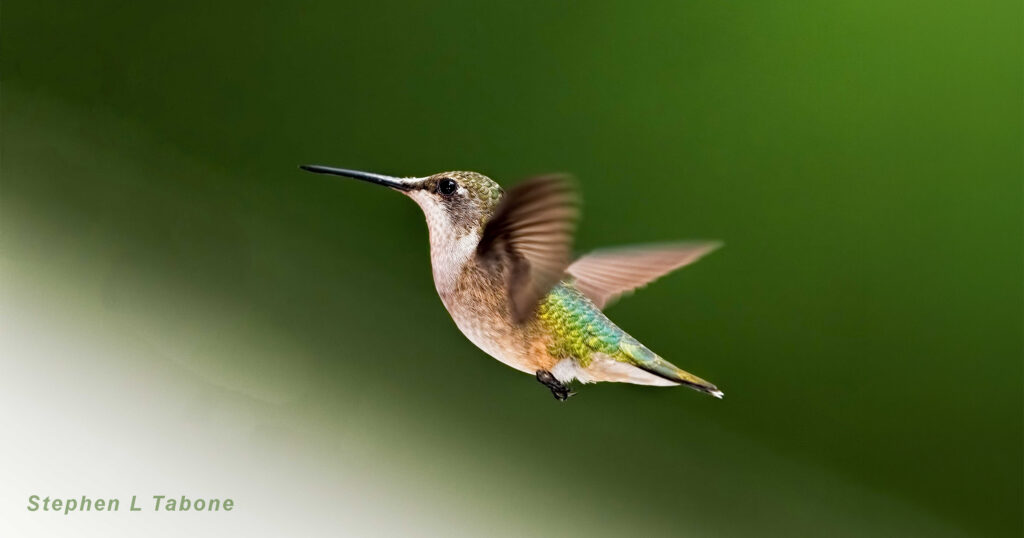
Its striking emerald-green crown and back, with a contrasting gray to off-white underbody, make the male ruby-throated hummingbird a pleasure to look at, but it’s his red throat (called a gorget) that gives the species its name and unique look. Females have more of a metallic green crown and back, a white throat, and gray underparts. While juvenile males closely resemble females, their throats can have gray streaks or spots before their notable red plumage develops.

Ruby-throated hummingbirds can beat their wings over fifty times per second, and they have roughly the same weight as a penny. These unique physical attributes give these little hummers a clear advantage in the air, as ruby-throated hummingbirds are exceptional flyers. They can hover, fly backward, sideways, and stop on a dime. With forward speeds that can exceed 30 miles per hour (48 km/h) and dives up to 60 mph (96 km/h), they can more than handle their own in the air. They do, however, have legs that are so short that they cannot hop or walk.

Male ruby-throated hummingbirds arrive at their breeding grounds in eastern North America and southern Canada before their mates and claim a territory in areas abundant with flowers; a necessity for their nectar and insect diets. When a female arrives, males perform horseshoe or U-shaped pendulum dives, sweeping in front of perched females with rapid wing beats and chirps. Nesting sites are chosen by females who build minute walnut-sized nests, incubate eggs, and raise chicks on their own. Males aggressively defend their territory, fighting not only their own tiny species but other larger birds as well.

Odds are the hummingbird you see visiting your bird feeder is likely a Ruby-throated hummingbird. They are the most abundant hummingbirds of North America, with an estimated 34 million individuals across their native range. They’ve experienced steady population growth for half a century and are listed as a species of least concern.
THE LONG AND SHORT OF IT
Length: 2.8 to 3.5 inches (7.1 to 8.8 cm)
Weight: 0.07 to 0.21 ounces (2 to 6 grams)
Wingspan: 3.1 to 4.3 inches (7.8 to 10.9 cm)
Dimorphism: Females are slightly larger
Lifespan: 3 to 5 years in the wild
Breeding: March through July
Offspring: 1 to 3 bean-sized eggs (typically 2)
Broods: 1 to 2 clutches per year
Ruby-throated Hummingbirds
Photographs by Stephen L. Tabone
– – –
A photographic journey along the migration routes of the world’s most fascinating species.
